|
To achieve optimum performance at 35,000', United Airlines uses CMMs to check a variety of airliner components from compressor blades to food service trays. At its Maintenance Operations Center in San Francisco, United employs five CMMs supplied by LK MSI (Brighton, MI). The machines, two G80C’s, a G80K, and a G80-Upgrade, are essential to the inspection of engine parts, advises Art Mehlhaff, United CMM inspection coordinator and team leader. “Our engineering department determines which parts have to be measured with the CMM, which is largely driven by the tolerances that need to be met in order to achieve optimal engine performance,” says Mehlhaff. He notes that, if the clearance between the compressor casing and the rotating compressor blades is greater than set tolerances, the engine will run hotter than specified. Elevated engine temperatures result in poor performance, increased friction, and possible engine failure. With the optimum clearances established by the manufacturer, the engine will operate at its design temperature and deliver its full thrust rating.
For engine components, United uses the CMMs to determine whether the parts have been remanufactured to the tolerances originally specified. If a part is out of tolerance, the airline can then document the part’s exact degree of error and present that information to the engine manufacturer. “The OEM can then determine the cause of the problem and improve the process to meet United’s specifications,” says Mehlhaff. The company estimates it saves approximately $500,000, and quite a few engines, each year by detecting out-of-tolerance parts prior to engine assembly and testing. The CMMs also have replaced the need for most of the expensive fixturing and other individual tooling required for routine measurements on a number of production engines. United estimates this has saved millions of dollars in fixturing costs and freed up a significant amount of shop floor space. The measurement units also allowed United to meet an unexpected challenge when one of its vendors announced it would no longer supply hard gage fixturing for any of their fan blades in future engines. Hard gage fixturing is traditionally required on fan blades to bring them back to original tolerances after use. With harsh weather and atmospheric conditions at high altitude, plus birds which may strike the blades during takeoffs and landings, blade damage is fairly common. A damaged blade will not provide peak performance. It is mandatory that these blades be reprofiled after sustaining damage. United avoids having to farm out this reprofiling to third-party vendors because of their in-house capabilities with the CMMs. Coordinate measuring units in the metrology lab are instrumental in research and development, explains Vic Cleland, metrologist and CMM calibrator. CMM measurements help certify certain vendor work and aid in the development and certification of in-house repair processes. “We can check parts for defects and correct them before they make it into production. To top it off, our labor costs and cycle times have plummeted. Parts that used to take two to three days to measure with special fixturing can now be inspected in just a few hours with a CMM,” says Cleland. Getting Connected
As with any computer-based system, there is a human learning curve that must be addressed. Cleland notes that the LK service team has been helpful when the need for troubleshooting arises. “LK is always quick to provide us with detailed instructions and step-by-step procedures to resolve any problems we encounter to get us up and running again,” says Cleland. LK MSI - March 2002 |
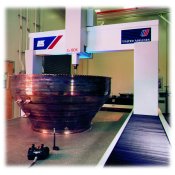 The maintenance center purchased its first LK CMM in the early 1980s. The additional LK machines were purchased following the decision to standardize on measuring equipment to maintain consistency and achieve compatibility. “Of our five CMMs,” says Mehlhaff, “the three in the inspection department are used primarily for final inspections of engines and engine components. The other two machines reside in the metrology lab, where they are used for inspection of incoming tooling, calibration of fixtures, and research and development.”
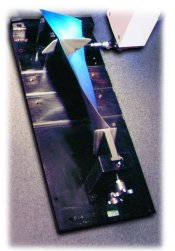 To further streamline inspection procedures, United is in the process of connecting all of their LK-supplied CMMs to a central computer server. This connection will enable operators to obtain complete program information for each particular component part. LK’s CAMIO CMM software will provide the operator with part setup information, accompanied by graphical reporting. This reporting will produce full-color pictorial inspection reports, all in a CAD interface. The central server also will provide operators with access to data for a much broader range of parts. For example, if an operator encounters an obscure or specialized part, he or she can search a vast database to determine whether a specific process exists for inspection of that particular part.