|
Modern Applications News: What has been the recent history of the waterjet industry? Dr. Olsen: “On the time scale of other machine tools, recent history includes the total history of the waterjet industry. Waterjets have been moving onto the scene very slowly since the 1970s, and abrasivejets a bit more rapidly since about 1980. “The first abrasivejet machines to come out were nozzles bolted to torch cutting tables. These early machines did not cut under water, so they were noisy and threw abrasive around. The motion mechanism did not require accuracy, because the nozzle itself wore significantly during a cut and was the precision limitation. As a result, people who are familiar with abrasivejets from the 1980s have the image of a big, messy monster that is not very precise. It was a tool of last resort for cutting otherwise-difficult materials. “In the 1990s, precision improved to a level comparable to other kinds of machine tools, largely through the development of an abrasive mixing tube with longer life. Boride Products in Traverse City, MI (now a division of Kennametal) came up with the enabling technology that allowed the nozzle to remain dimensionally stable while cutting a part. Prior to that, a nozzle life of 3 – 4 hours running at the same high pressures of today was considered good. With nozzles now lasting 50 – 100 hours, it became worthwhile to mount the nozzle on a more precise mechanism. “The remaining technology that improved precision was the emergence of low-cost, powerful PCs. The abrasivejet is not a rigid tool; it bends backwards as it is moved along the toolpath. To compensate for this, you need computing power and access to the interpolator within the control to precisely manage the jet traverse speed as a function of part geometry to achieve precision. The first dedicated abrasivejet controller ran under DOS and used the PC timer chip for speed control. Windows™ versions are more complex than DOS because Windows is multitasking and cannot be used for real time. Our Windows version sends data via a USB cable to a storage buffer and timer. “OMAX is currently ranked No. 2 in sales in the industry. I would estimate that there are about 200 – 500 machines per year being sold into job shops by all manufacturers combined. The technology as a whole has experienced relatively slow growth, possibly due to the training and background of the shop owners. No one has been formally educated in the use of abrasivejets, and too few know what they can do. Getting this knowledge into the marketplace is the major obstacle to the machine’s widespread use.” Modern Applications News: How is OMAX creating abrasivejet solutions for job shops? Dr. Olsen: “First and foremost, we are striving to build a precise machine that is easy to use with a minimum operating cost. Focus group studies tell us that abrasivejets are perceived as expensive-to-operate, high-maintenance, specialty tools, while the advantages are largely unknown. This situation is great for those who understand the advantages, and they are making very good money using abrasivejets. “Education is important in opening the market so that every shop can understand and use the tremendous advantages of the technology. One of our educational efforts is similar to what Apple Computer did, only for getting abrasive-jet equipment rather than computers into the schools and universities. We have a program that makes it possible for schools to acquire an abrasivejet at low cost. I think that, if students can come out of universities expecting to find abrasivejets in the shops and knowing what they can do, it will benefit everyone.
“The accompanying pie charts show the economic results in comparing an hour of operation of a conventional CNC mill and an abrasivejet machining center. The selling rate (perhaps on the high side) for an hour’s operation of a CNC mill is about $65. Abrasivejet machining time is sold for about $150 per hour, and the customers who buy the parts are very happy because of the low part price afforded by the high productivity. It is true that, in keeping with the perception mentioned earlier, the operating costs are higher than for a CNC mill. Yet, the amount that the shop owner gets to keep for the hour of work is three times that of the mill. This is the main message that we are trying to get out to job shops worldwide. “These economic advantages are emphasized when batch sizes are small, because parts can be made directly from a CAD (computer-aided design) DXF (digital exchange format) file, and there is only one tool to set up and qualify. When doing very high-volume work, you can afford to spend large amounts of money on tooling because the cost per part is low. For such high-volume work, the abrasivejet may still have the edge if the part is particularly suited to abrasivejets because of geometry or material considerations.
“We provide training for maintaining and servicing the abrasivejet. With abrasivejet, the maintenance person spends several hours each month maintaining the machine, and the operator does everything else. The more skilled person should be servicing the abrasivejet, rather than operating it. “Another area we have emphasized is precision. The machines are built using machine tool grade linear rails and ball screws. If I am cutting a ½"-thick steel part, for example, I would feel quite comfortable about holding a tolerance of ±0.002". We cannot achieve the finish of wire EDM (electrical discharge machining), but we can achieve close to its tolerances. We cannot make mirror finishes; the surface will always look sandblasted because that is the cutting process. However, for many applications the abrasivejet produces an acceptable finish. You can place holes accurately and do final sizing with a reamer or tap the hole directly. “Finally, we have tried to build an extremely safe machine. People who are familiar with abrasivejets do not see it as being hazardous. I would be more wary of a band saw, because you may have to work with your fingers near the blade. Also, flying chips or a manual lathe, where the operator stands with a file near the rotating chuck, can often be a lot more dangerous than an abrasivejet. In order to get a good part with an abrasivejet, you need a standoff distance of less than 1/16"; and there is no human feature that can inadvertently wander into a gap this small and be cut accidentally. Abrasivejet also is intrinsically safe without guards or gates.” Modern Applications News: What new developments and improvements are planned for abrasivejets in the future? Dr. Olsen: “Our developments are all geared toward expanding the market. Improving precision expands the number of parts that can be made, and a broader range of machine sizes fits the needs of a greater number of shops. We are currently in the design phase for a three-axis attachment for tilting the nozzle. This is intended to remove the slight taper left by a vertical jet and for purposely making controlled taper where it is desired. “Further precision improvements through reduced nozzle wear must be made by the suppliers, such as Boride. We do not have a materials development lab, so we rely on our suppliers for material. Almost all machine manufacturers use Boride mixing tubes, and we do not see much change in nozzle design. Nozzle wear manifests itself mostly as larger and larger tool diameter. This effect of the wear can be adjusted out by changing the tool offset. You do this by measuring the part, determining the change from expected dimension, and entering the new tool offset into the control. Other effects, such as increased taper from a worn nozzle, must be minimized by either a tilting head or replacement of the nozzle. “Other precision improvements will come through improved software that models the behavior of the jet even more accurately than the current software. Today’s PCs give us the computing power to manage eight axes and produce abrasivejet parts to tolerances approaching those of wire EDM machines, but at a much higher speed. “I might mention as an aside that people who are PC-literate seem to gravitate to the abrasivejet naturally. It is just a PC peripheral, so to speak. With a Windows-based control, you can tie into a company’s network. Then you can have access to the Internet, and all kinds of opportunities open up. For example, I can imagine a company having multiple manufacturing plants with everything tied together over the Internet, keeping track of what each machine is doing. I also think that the Internet is useful in helping to teach people about abrasivejets. There is a website called ‘waterjets.org’ that presents pretty much all there is to know about this technology without a commercial approach. “Our next new machine size will be a 2m x 4m table. This will be a dual-head machine intended for the precision fabrication market and large aerospace parts. Such a machine will require a suite of software including nesting programs to minimize material waste. We are also just beginning to study the market for a very low-cost, small machine that might serve as a kind of ‘calling card’ to get more shops interested in the technology.” Modern Applications News: What are your corporate goals for the industry and the marketplace? Dr. Olsen: “I am personally interested in making it easy for a shop or ultimately even a hobbyist to make one of something. The problem with the NC (numerical control) machines in small prototype shops is that, by the time you get the program working and all the tooling set up and qualified, you could have had the part in your hand using manual machines. With abrasivejet cutting, you can have the part in your hand before you can even set up a manual machine. “A second corporate goal is to expand use of our controller technology. It is now capable of running eight coordinated axes at a very low cost. The control is just a software component, and the machine tool becomes a PC peripheral. “Chuck Hutchins of MDSI (Manufacturing Data Systems, Inc.) sees the advantages in this approach just as we do. I get to talk with him now and then, and he has very similar ideas about the advantages of using PC technology. We followed slightly different routes of how to do it than he did, but we now have a similar capability.” Modern Applications News: What do you forecast as the future for abrasivejet machining? Dr. Olsen: “The future of abrasivejet is to become fully a mainstream machining process. We are just like all the other machining approaches. In fact, we are better at it when it comes to making one-of-a-kind parts, one at a time. I would be very unhappy if, within 10 years, there are more wire EDMs than there are abrasivejets, which are more useful, more productive tools than wire EDMs. “In the same 10-year period, I would be equally astonished if there were more abrasivejets than there were vertical Bridgeport-style machines. Somewhere in the middle of these two situations is the evolving market for abrasivejets in the next decade. Currently, the industry is somewhere between 5% and 10% of the potential future sales rate.” - June 2001 |
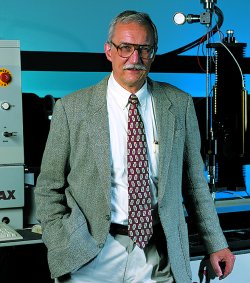 This is another exclusive Modern Applications News interview by Larry Olson, Editor, with a metalworking industry leader: Dr. John H. Olsen, Co-Founder and Vice President of Operations, OMAX Corp.
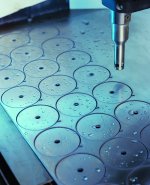 “There are many shops for whom lead time and small batch sizes are a problem. Smaller batches are driven by the need to reduce inventory either in-house or at the shop’s customer. If these shops were cutting aluminum, for example, they might say ‘Why should I use a waterjet? I can cut aluminum on my mill.’ The answer is that today’s abrasivejet machines lease for far less than a skilled machinist is paid, and that a relatively unskilled operator can out-produce several skilled machinists in quick-turnaround work.
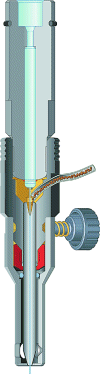 “The abrasivejet is actually easier to learn and operate than almost any other machine tool. However, abrasive-waterjet has different — and perhaps weird — maintenance requirements. Most machinists can judge when tooling is worn or broken and needs to be replaced or rotated. With an abrasivejet, the operator must learn to recognize when the nozzle is worn and needs replacement. In addition, ultra high-pressure pumps require more maintenance than coolant pumps do; so, the pump should be maintained every 300 – 500 hours. If proper cutting pressure cannot be achieved, then you will find — and this applies to every abrasive pump on the market — that pump components will need replacement.