eNews
Improving Plasma Cutting Quality – Part II
Keep these practices in mind to optimize plasma cutting for better fit-up, increased productivity, and lower operating costs
When using a plasma cutter, a clean cut relies on several factors. Don Keddell, training specialist at Miller Electric Mfg. Co., Appleton, WI, offers tips to get the most out of the machine, including consumables, posture, direction of travel, amps, travel speed, and guides.
Tips on Tips
Tips focus the plasma stream to the work piece. The machine that Keddell uses for demonstration uses 80 amp and 40 amp tips plus extended versions of those for increased reach, as well as gouging tips.
He suggests the use of a higher-amp tip when cutting thicker material. Because a lower-amp tip has a smaller orifice, it maintains a narrow plasma stream at lower settings for use on thinner material. Using a 40 amp tip at an 80 amp setting will distort the tip orifice and require replacement. Using the higher amp tip on the lower settings will not focus the plasma stream and lead to a wider kerf. Use extended tips to reach further, in corner cutting, when using patterns, or in tight areas.
Gouging tips spread the plasma stream and remove a lot of material at once, letting the arc remove a large amount of material in a single pass.
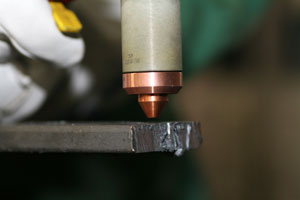
Tips focus the plasma stream to the work piece. Use a higher-amp tip when cutting thicker material, and a lower-amp tip on thinner material because it has a smaller orifice to maintain a narrow plasma stream.
If using clean, dry air and making longer cuts, expect to get about two hours of continuous cutting time from the consumables, Keddell said. Continuously restarting the pilot arc by triggering the torch will shorten the life of consumables. Touching the tip to the material without a drag shield in place will cause double arcing as the electrical current tries to find the shortest path to the workpiece. This will decrease consumable life.
Many plasma cutters come with a drag shield that is placed on the cutting surface during operation, maintaining an optimal 1/8" standoff, ideal for unsteady hands or pattern cutting, as well as offering longer tip life, Keddell said.
When not using a drag shield, maintain a 1/16" to 1/8" distance between the tip and the workpiece. As noted, touching the tip to the work surface will affect the cut quality and consumable life. However, moving the tip further away from the workpiece reduces the cutting capacity of the unit.
Get in Position
If not using a drag shield, or when more precise cuts are needed, Keddell recommends using the non-cutting hand down as a guide for the cutting hand. This rest hand position provides freedom of movement in all directions while steadying the cutting hand and helping to maintain a constant standoff.
Rehearse the cut to make sure it can be made in one continuous movement. It’s difficult to start an arc in the middle of a cut and maintain a clean cut-line.
Except when beveling, keep the torch perpendicular to the workpiece.
In starting a cut in piercing thin material, the arc may be able to punch through with little or no backsplash. However, on thicker material, start with the torch on a 45° angle so the first blast of metal has somewhere to go. If not, the metal will splash back and quickly wear the consumables.
Pull, Don’t Push
Human mechanics makes it easier to pull a torch than push it. A plasma cut contains a beveled edge and a straight edge. If this is important to the project, plan accordingly. Plasma swirls as it exits the tip, biting on one side and finishing off on the other. Keddell said an easy way to remember it is to think of the plasma torch as a car without reverse. Whichever way the torch is traveling is forward and the passenger side is always the straight side.
Finding the Perfect Speed
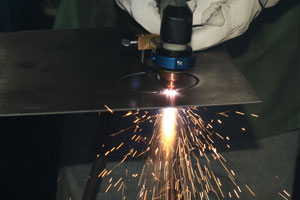
Straight and circle guides for plasma cutters are available for precise cutting
The owner’s manual should contain a chart that compares material thickness to travel speed in ipm.
The faster the cut – especially on aluminum – the cleaner it will be,†Keddell said. On thicker material, set the machine to full output and vary the travel speed. On thinner material, turn down the amperage and change to a lower-amperage tip to maintain a narrow kerf.â€
To determine if the speed is too fast or too slow, visually follow the arc that’s coming from the bottom of the cut. The arc should exit the material at a 15° to 20° angle opposite the direction of travel. If it’s going straight down, it means the speed is too slow, and there will be an unnecessary build-up of dross or slag. If the speed is too fast, it will spray back. Since the arc will be trailing at an angle, at the end of a cut, slow the cutting speed and angle in the torch to cut through the last bit of metal.
Guiding the Way
For marking the material to be cut, use either a black marker or white chalk. Either extreme makes the marks easier to see.
For more precise cutting, clamp a straight edge to the workpiece to guide the torch. For making multiple cuts of the same shape, create a template. Straight and circle guides are available for precise cutting.
Make sure the guide isn’t flammable. Keddell said he prefers aluminum because of its smooth surface, but said that due to its electrical conductivity the aluminum should touch the torch cup or drag shield and not come into contact with the tip.
While it may be easy to unpack a plasma cutter and begin cutting, take time to become familiar with its operation. Read the owner’s manual and keep these tips in mind. It will help optimize plasma cutting for better fit-up, increased productivity, and lower operating costs.
For more safety tips as well as information about selecting and using a plasma cutter, visit www.millerwelds.com/resources/improving-your-skills/plasma/
Want more information? Click below.
Miller Electric Mfg. Co.
Please rate this article:
Very interesting, with information I can use
Interesting, with information I may use
Interesting, but not applicable to my operation
Not interesting or inaccurate
Comments: