 LOWER YOUR TOOLING COST PER CUT
If you’re machining hardened ferrous or non-ferrous parts, CALL MASTERTECH! No matter who your current vendors are, we’ll show you the best choices in PCD & PCBN tooling. We manufacture a variety of diamond tooling and we’ll recommend the very best tooling for your application—ours or theirs! www.mastertechdiamond.com
Coolants / Lubricants / Filters
30-day MQL Trial Becomes Permanent
Minimum Quantity Lubrication Solves Cleaning Problem for Machining Operation.
Barry and Meriel Fulford, owners of Production Metal Stampings in Milton, FL, speak easily about what they feel is the Panhandle company’s most obvious strength. “Our creativity and ability to keep an open mind coupled with a strong network of resources to draw from for solving problems, have helped us to remain successful.”
It was exactly this openness to new technology that helped the Fulfords and their machinists use MQL (minimum quantity lubrication, sometimes referred to as near dry machining) to resolve an enormous issue they were having with secondary cleaning operations on a key job.
PMS runs machining jobs for customers in South Florida, Texas and Mexico that involve milling, drilling and threading slots in 24' long aluminum alloy tubing. The materials worked on the company’s HAAS VF-3SS are a range of standard alloys such as 6061 T6, 6005 T5 and others, mostly round tubing and occasional flat or round bar with similar requirements.
The amount of machining required on this material presented significant problems in meeting customer requirements. When the parts were shipped they needed to be clean, dry and free of any chips or contamination as well as contain smooth finished slots that needed no additional deburring. These reasonable requirements left the team at PMS with several challenges to face.
Chips Complicate Cleaning
Because of the amount of machining necessary on each piece, chips were extreme and difficult to manage. The flood coolant pushed the chips into the machine vice jaws, inside the tubing and into the tool change mechanisms and compartments. The chips also found their way into the excess coolant and remote corners of the machine. The results were excessive cleaning required on the part and to the machine. Machine downtime was causing them delay and the cleaning was complicated but it worked...sort of.
 A Flash Of Genius
Plan to attend IMTS 2010, Sept 13-18 at Chicago’s McCormick Place, where you can see and compare a world of machines, technologies and tools side by side. Where ideas are born. Where processes are improved. Where your technology is advanced. Where you see how to become more competitive. Visit IMTS.
Barry Fulford explains that manufacturing in Florida means dealing with hot, humid days and unpredictable summer rains. PMS had to not only predict, but guarantee the delivery schedules for the finished product. An elaborate trough was constructed for drying the 24' lengths once they were hosed clean inside and out. The company experimented with an air knife, fans, and an air curtain in attempts to expedite the drying process and clean all chips from inside the tubing. Presenting the material dry inside and out sometimes simply took too long, or necessitated sending only partial shipments. Since cleaning, deburring and drying proved more complicated than the machining itself, it didn’t initially occur to the team to change their machining processes to reduce the secondary activities. When a local lubrication rep stopped in one day and suggested that the company look into machining the parts using a “near dry” process, Fulford was interested, but thought there could be risk. Nearly eliminating the flood coolant could mean even more difficulty moving chips, not to mention the possibilities of damaging tooling and expensive material. It was when a faculty member and long time friend of Fulford also mentioned the near dry process, referring to its more commonly used designation MQL (minimum quantity lubrication), that Barry decided to see what he could learn.
Lubrication Process Tripled Tool Life
During his research he discovered some videos on the Internet by UNIST, Inc. See one at www.youtube.com/watch?v=Rgs5u5UOKcw&feature=channel. UNIST, based in Grand Rapids, MI, manufactures equipment specifically used for MQL processes. The company specializes in assisting manufacturing operations to make the transition from flood cooling to MQL. “It was one thing to discuss using less lube,” stated Fulford. “But when I saw the videos and was able to observe the process, it convinced me that it might work with what we were doing.”
Fulford contacted his HAAS Tech Center to discuss using the process in the VF-3. Since HAAS has worked closely with UNIST in development of MQL retrofit solutions and recommends UNIST Coolube 2210 for MQL machining, the transition for Fulford was simplified.
The aspect of UNIST’s approach that most interested Fulford is their offering of MQL systems for evaluation. The company provided PMS with a system to test on their machine for a 30 day period with the option to return the system if it failed to provide specific improvements to their operations.
Fulford and his team approached the MQL evaluation with an open mind. Since cleaning already had them up against time restraints, any slowdowns in feed rates, more frequent tool changes or other delays in the process wouldn’t work. They found however, that these were non-issues. Using the MQL system to apply small amounts of vegetable based lubricant to the tooling and machining surface, they were actually able to increase their feed rates. And while they adopted a different tool geometry to work with the lower volume of coolant, their tool life has more than tripled using the MQL process.
Secondary Cleaning Eliminated
The real benefit according to Fulford is the ability to completely eliminate the secondary operations on the aluminum tubing. “We machine the tubing now, and it’s ready for delivery,” says Barry. This result provided positive impact in both the shop floor environment and in the bottom line for the company. Using the flood coolant caused the machine to need more frequent cleanings. The cleaning was not only time-consuming, but annoying for the operators. “The chips were like little needles,” says Fulford. If they got into gloves, clothing, etc. it was not pleasant. They were also wet, difficult to remove and hard on our tools.”
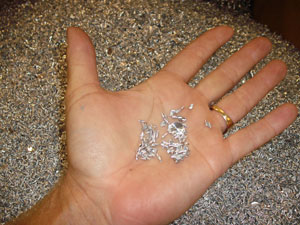
The chips using the MQL lubricant and equipment are now pigtailed, as well as clean and dry. Now they fall to the bottom of the machine on their own. The air created from the increased speed in machining moves them away from the work area and into the corners of the machine where they are easily swept out. Since the chips are dry the company now receives a higher price for the scrap.
Deburring is also no longer necessary. The quality of the slots has improved to the point that the customer has actually commended PMS for making the process change and increased their confidence in Fulford’s company. On multiple occasions customers have expressed their satisfaction and provided positive feedback regarding the improved condition of the finished parts.
Ongoing MQL Evaluation
PMS has not limited its use of MQL to this one application, but found the process also works on smaller aluminum, plastic and steel parts. Machining a 0.035" to .065" wide groove in steel tamperproof bolts for the telecommunications industry can now be completed with no excess water based coolant, which means no more rust during shipping when the bolts sometimes sit for a week or more at the customer site.
Over the last 20 years Barry and Meriel Fulford have seen many new developments They are excited about what new capabilities they will be able to provide customers and prospects using MQL in their machining process. “We’re still learning and have to run flood coolant on other jobs while we find out what works. In this manufacturing climate we plan to continue looking at creative solutions that will be good for our customers.”
Want more information? Click below.
UNIST, Inc.
 Are you looking for a more efficient, less costly way of verifying your parts?
While you may be familiar with (or even own) check fixtures, you may not realize that there is a more efficient, accurate alternative available that produces a true return on investment.
Download this complimentary white paper to learn more about the solution that yields actionable, quantifiable data that can help you improve your products and become more profitable.
Please rate this article:
Very interesting, with information I can use
Interesting, with information I may use
Interesting, but not applicable to my operation
Not interesting or inaccurate
Comments:
December eNews
Feature Articles
CUTTING TOOLS
Time—The Critical Factor
Read the full article
MACHINING / TURNING CENTERS
Screw Machine Giant Takes a New Market Direction
Read the full article
Thinking “BIG” In a Mean Economy
Read the full article
COOLANTS / LUBRICANTS / FILTERS
30-day MQL Trial Becomes Permanent
Read the full article
Clean Coolant = Higher Spindle Times
Read the full article
WORKHOLDING
Dedicated Fixture Slashes Time
Read the full article
CNC / MACHINE CONTROLS
CNC Upgrade Restores Machine to Full Productivity
Read the full article
New Products
Cutting Tools
View products …
Machining Centers / Turning Centers
View products …
Coolants / Lubricants / Filters
View products …
Workholding
View products …
CNC Machine Controls
View products …
Toolholding / Tool Management
View products …
News
Industry News
View news …
Association News
View news …
Brochures
Catalogs, Brochures and Informational Materials
View brochures …
Events
Methods to Hold Multitasking Machining Seminars
View events…
SolidWorks World 2010
View events…
Medical Design & Manufacturing West
View events…
FMA's 14th Annual Toll Processing Conference: Roadmap to Recovery
View events…
SUBSCRIBE
Subscribe to MAN eNews
Click here…