Lisega Eliminates Punishing Labor with Intelligent Automation
By automating post-processing, the Teqram EasyGrinder helps shops eliminate manual bottlenecks without complex programming. Recently, Lisega, a pipe support system specialist, successfully integrated this AI-driven 3D vision system to handle high product variation in their heavy sheet-metal blanks, replacing punishing manual steps with a seamless, fast workflow.
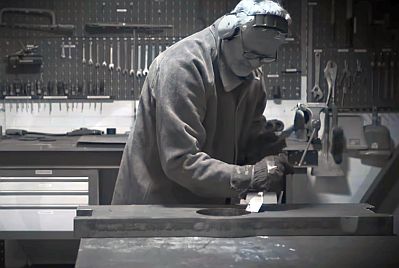
For decades, the post-processing of flame-cut and plasma-cut heavy parts has been a stubborn roadblock to peak efficiency. Tasks like removing stubborn slag, breaking sharp edges, and grinding precise radii are traditionally viewed as necessary evils. They are physically punishing, incredibly noisy, dusty, and notoriously difficult to replicate consistently from one shift to the next.
As global quality standards climb higher, relying on manual labor for these grueling finishing steps is no longer a viable strategy for forward-thinking manufacturers.
Lisega, a global heavyweight specializing in industrial pipe support systems, found itself facing this exact operational hurdle. The company manages a massive, modular product portfolio that features tens of thousands of standardized components.
Inside their production facilities, the post-processing of heavy sheet-metal blanks required multiple manual interventions. The process devoured significant time and tied up highly skilled labor that could have been deployed on more complex tasks. To make matters more challenging, a rising tide of product variation meant that maintaining uniform, top-tier edge quality across every single piece was becoming an uphill battle.
VIDEO: AI-Powered Robotic Grinding
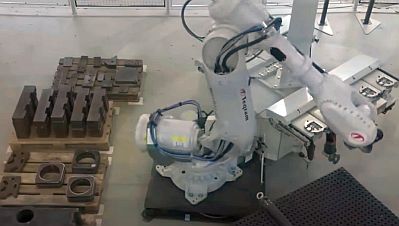
Recognizing that manual grinding had reached its absolute limit, the company began searching for a technological leap to modernize its workflow. The solution arrived in the form of the EasyGrinder, an automated system developed by the robotics and vision technology experts at Teqram.
For many manufacturers, the biggest barrier to deploying industrial robots is the bottleneck of software programming.
Traditional automation systems require engineers to painstakingly program code for every single part variation, a reality that destroys the financial return on investment (ROI) for high-mix, low-volume production runs. Lisega ran the numbers and realized that a conventional robot would simply not be economical given their diverse product range.
The EasyGrinder bypasses the programming bottleneck through the integration of artificial intelligence and advanced vision systems. Instead of following rigid lines of pre-written code, the robot relies on a 3D vision system to see the work environment in real time. It identifies each unique workpiece as it arrives, automatically analyzes its specific geometry, and independently selects the correct tools and grippers required for the job.
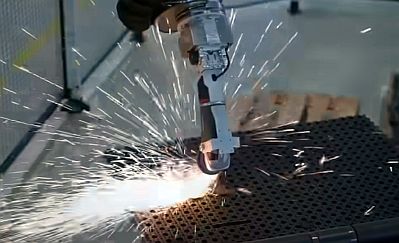
This shifts the role of the human operator from a manual laborer or a complex programmer to a high-level quality controller. The operator simply defines the desired quality outcome on a control screen, and the AI handles the execution logistics. This capability allows the system to automate the entire post-processing workflow in one single, seamless sequence without a single line of traditional robot programming.
The operational impact of this technology on the production floor is immediate. The system handles the entire spectrum of finishing tasks required for heavy plate fabrication. It clears away heavy slag, cuts clean edge chamfers, removes hazardous lead-in burrs, and grinds edges to a precise radius of R2.
By replacing multiple fragmented manual steps with a single automated cycle, the system yields dual benefits: processing speeds skyrocket, and throughput times collapse. More importantly, the finished quality remains perfectly uniform. The robot applies identical pressure and angles every single time, meaning the hundredth part off the line looks exactly like the first, regardless of structural complexity.
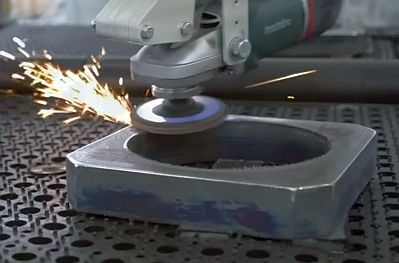
Beyond the productivity metrics, the transition to intelligent automation addresses a critical human resource challenge in modern manufacturing: workplace safety and ergonomics. Heavy grinding is notoriously hard on the human body, exposing workers to repetitive strain injuries, extreme noise vibration, and hazardous airborne dust.
By shifting these harsh tasks to an autonomous system, companies can protect their workforce from injury while redirecting their valuable operators to safer, more engaging, and higher-value technical roles within the factory.
Lisega's successful integration of this technology proves that the automation of heavy finishing processes is no longer an experimental concept reserved for high-volume automotive lines. By pairing robust robotics with intelligent vision systems, modern manufacturing facilities can finally eliminate the manual grinding bottleneck, achieving consistent quality, accelerated throughput, and a safer working environment for their teams.
Want more information? Click below.
Rate this article
View our terms of use and privacy policy