Meet the Robot Doing the Heavy Lifting at Thunder Creek
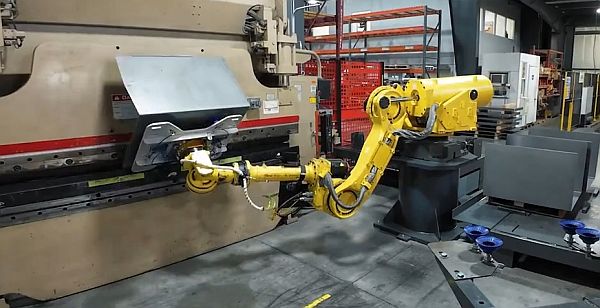
Struggling with plant-floor bottlenecks and the heavy labor shortage? Fabricators are finding relief by replacing punishing manual tasks with automated cells, as seen at Thunder Creek Equipment, where a FANUC-powered robot now handles 150-pound steel plates on a 135-ton press brake.
The metalworking industry is facing a dual challenge: skyrocketing product demand paired with a persistent shortage of skilled factory-floor labor. In this demanding environment, traditional manual operations -- especially heavy machine tending -- frequently become severe production bottlenecks.
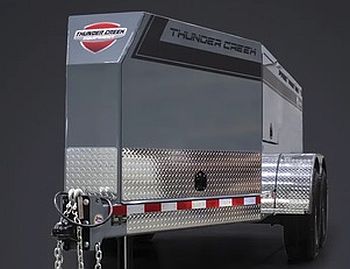
For companies like Thunder Creek Equipment, an Iowa-based manufacturer of high-performance fuel and service trailers, overcoming these operational hurdles meant fundamentally reimagining their approach to fabricating heavy steel parts.
On Thunder Creek's production floor, the press brake station was one of the most labor-intensive and physically punishing operations. Operators spent their shifts manually loading and unloading massive steel plates, some stretching over six feet long and weighing more than 150 pounds. This repetitive, grueling task created significant ergonomic strain and safety hazards while limiting throughput.
Recognizing the need for a technological shift, Thunder Creek partnered with custom systems integrator The Way Automation to design and deploy a fully automated robotic press brake tending cell.
Centered around a high-payload FANUC R-2000 industrial robot, the newly engineered cell automated the entire material handling sequence for a 135-ton Cincinnati press brake. The heavy-duty robot seamlessly handles the heavy lifting, picking up raw steel blanks, positioning them with flawless precision through complex bend sequences, and stacking the completed forms.
For metal workers, the benefits of transitioning to an automated cell extend far beyond simple labor substitution. The implementation immediately unlocks a dramatic surge in plant efficiency:
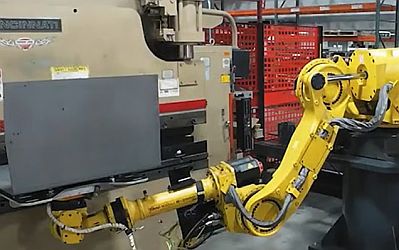
- Consistent Cycle Times: Unlike human operators who experience fatigue over an eight-hour shift, an automated cell maintains a predictable, unyielding pace, allowing production managers to accurately forecast daily output.
- Elimination of Ergo Hazards: Removing workers from the immediate path of heavy, sharp steel sheets dramatically reduces workplace injuries and workers' compensation risks.
- Optimized Floor Space: By replacing an underperforming panel former, Thunder Creek maximized their parts-per-square-foot yield within a highly compressed manufacturing footprint.
Crucially, the precision of robotic machine tending delivers massive quality dividends downstream
Because the robot positions every plate with repeatable accuracy, bend angles remain perfectly consistent from the first part to the last. This structural uniformity directly improves subsequent manufacturing steps; for instance, Thunder Creek's downstream welding robots now operate with significantly higher efficiency because they no longer have to compensate for part-to-part variances.
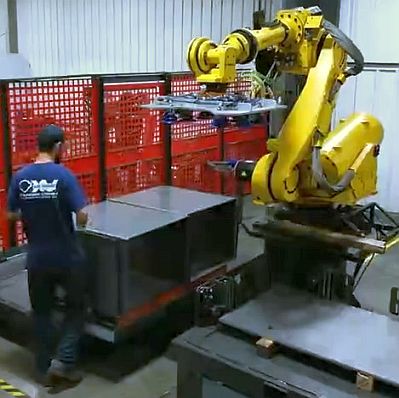
Furthermore, integrating advanced automation does not require a complete overhaul of a manufacturer's workforce skillset. Despite the advanced engineering powering the FANUC-driven cell, the interface is designed to be highly intuitive. Existing operators can easily manage and run the cell without any prior robotics or programming experience, allowing them to shift from grueling manual labor to higher-value, technical supervisory roles within the facility.
The success of Thunder Creek's initial automation investment has already triggered the installation of a second, matching robotic press brake tending system. Their experience proves that for the modern metalworking industry, automated cells are no longer a luxury -- they are a vital mechanism for scaling throughput, protecting workers, and securing a competitive edge.
Want more information? Click below.
Rate this article
View our terms of use and privacy policy