Bionic Prosthetic Arm Teaches Industrial Robots Human Dexterity
Replicating the human hand's natural dexterity is one of the most stubborn engineering roadblocks in industrial automation. While factory arms excel at repetitive, highly precise movements along fixed paths, they traditionally struggle when dealing with unpredictable shapes, fragile materials, or changing surface textures.
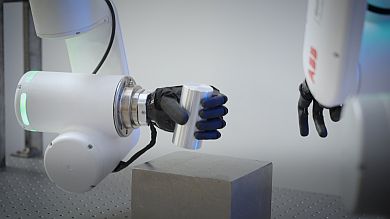
To shatter this barrier, ABB Robotics has formed a unique partnership with California-based bionics pioneer PSYONIC. Instead of relying on traditional mathematical coding to program grip patterns, this collaboration fuses artificial intelligence with real-world human manipulation data collected directly from advanced prosthetic use. The resulting technology promises to fundamentally redefine how robots perceive and interact with the physical world.
At the exact center of this technical leap is the integration of PSYONIC's Ability Hand with ABB's high-precision GoFa cobot.
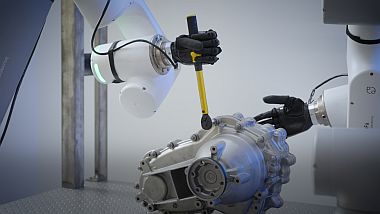
Originally engineered as a lightweight, multi-articulating bionic prosthesis for humans, the Ability Hand utilizes specialized myoelectric control, tactile pressure sensors, and compliant mechanics. Its integrated vibration feedback systems detect sudden contact, subtle grip forces, and the exact moment an item is released.
Furthermore, its flexible fingers naturally conform to highly irregular or easily deformable objects. By mounting this advanced bionic hand onto an industrial collaborative robot, the partnership transforms a piece of healthcare hardware into a sophisticated data collection device.
VIDEO: ABB Robotics -- Psyonic
As Dr. Aadeel Akhtar, the founder of PSYONIC, points out, overcoming dexterous manipulation is primarily a data challenge rather than a hardware limitation. Because the exact same bionic hand is deployed on both human amputees and industrial robotic arms, engineers can capture high-fidelity, real-world data regarding human movement, contact points, and grip force adjustments.
This human-generated data stream is then fed into neural networks to train the physical AI driving the robot. This breakthrough closes a long-standing gap in automation. Instead of spending weeks programming logic for every possible object variation, the robot utilizes machine learning to inherently understand how to hold a fragile piece of glass, a flexible rubber hose, or an irregularly shaped automotive component.
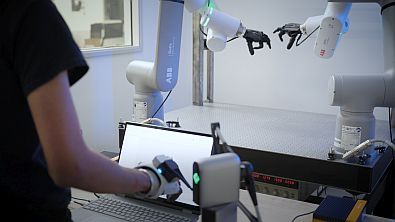
The physical execution relies heavily on the structural reliability of the ABB GoFa cobot, which provides the necessary precision and repeatability to execute these learned behaviors safely. The cobot's precise positioning ensures that subtle variations in finger alignment and grip pressure are executed flawlessly under rigorous shop-floor conditions. This capability directly supports ABB's vision of Autonomous Versatile Robotics (AVR), which focuses on building machines that can autonomously sense, reason, and react to dynamic environments.
According to data from the International Federation of Robotics, implementing advanced gripping and digital integration can slash overall engineering timelines by up to 30 percent.
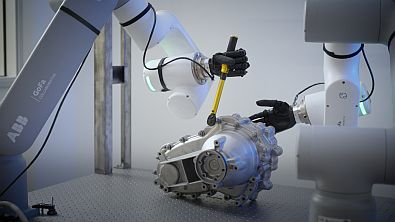
By reducing implementation times and eliminating the need for expensive custom tooling, this partnership directly enhances the financial return on investment for automated cells. More importantly, it opens up a massive array of new applications across industries like aerospace, automotive, logistics, packaging, and life sciences. By handing over highly repetitive, variable, and ergonomically challenging handling tasks to adaptable cobots, human workers are protected from injury while factories could achieve unprecedented levels of operational flexibility.
Want more information? Click below.
Rate this article
View our terms of use and privacy policy